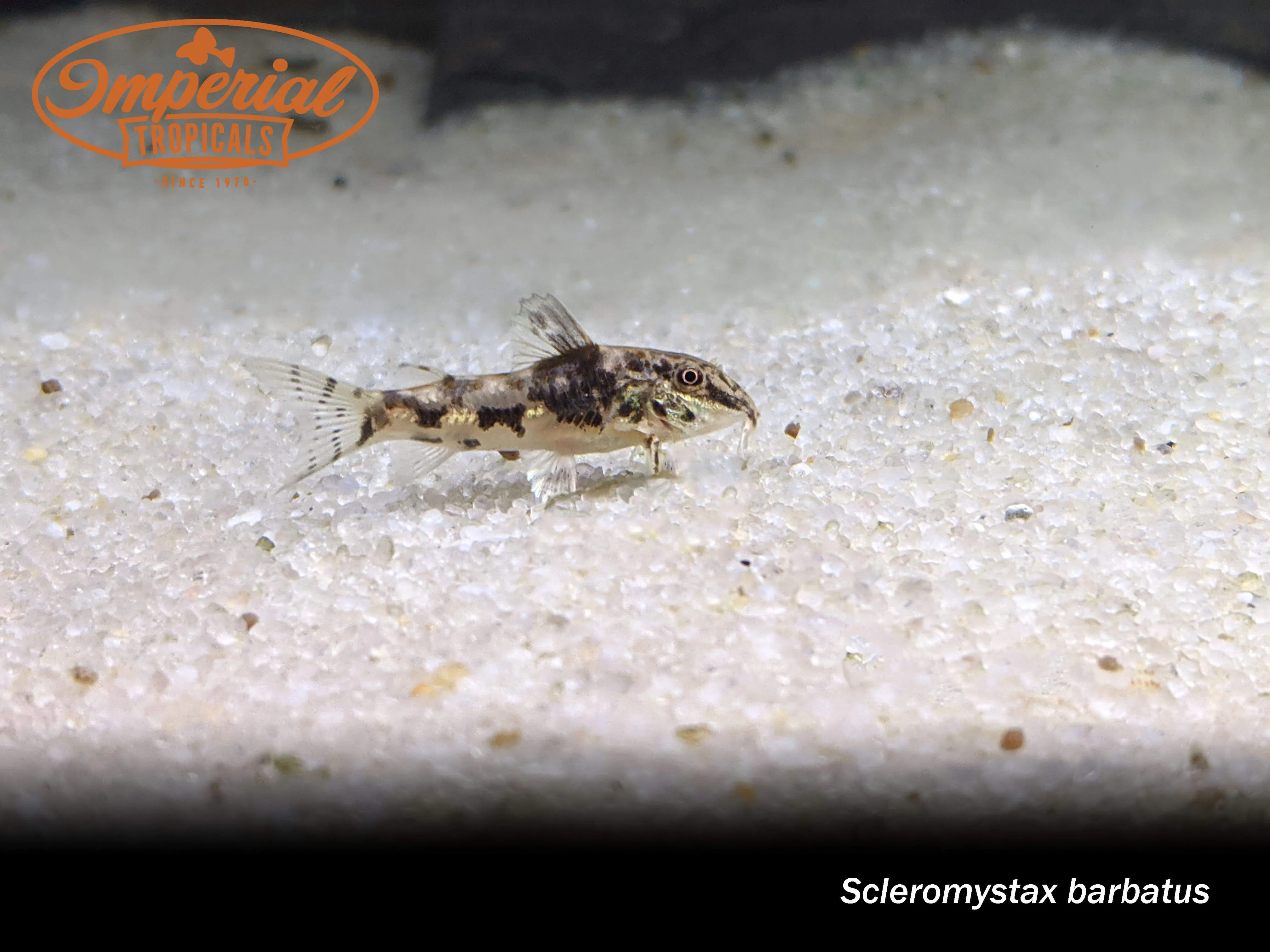
Scleromystax barbatus
Remarks: Scleromystax barbatus are one of the largest, if not the largest Corydoradinae known. They are native to the coastal regions of Brazil and are typically found in areas with very cool, oxygenated water. These conditions must be replicated in the home aquarium to keep these fish healthy as they do not tolerate warm water. In the wild, they use their long snouts and whiskers to search for food on the sandy bottom. In males, these snouts are also adorned with a "beard" giving them the nickname, "Bearded cory."
Young Scleromystax barbatus have silver or gray mottled bodies with no visual differences between males and females. Upon maturity, they can be easily sexed as males and females look vastly different. Adult females will have pretty much the same coloration as juveniles. Mature males have black and gold bodies with spots covering the head and shoulder along with a gold stripe starting at the nose and extending back to the beginning of the dorsal fin. Males also display extended dorsal and pelvic fins that can reach an inch in length. This makes for a truly beautiful species that provide lots of activity in the bottom area of your tank. Such differences between males and females aren't the only thing setting Scleromystax barbatus apart from other Corydoradinae. Another attribute that makes them different is how the males can be very territorial towards other males, leading to sometimes very violent battles for territory. However, this should not a problem in a tank longer than 3.5' and if there aren't more males than females.
Corydoradinae are small, peaceful catfish that are active shoalers and will stay near conspecifics, making for a lovely sight. They feed by searching through sand with their barbels, making such a substrate necessary for their long-term health. Gravel substrates tend to be abrasive and damage the barbels, leading to infections and an inability to find food.
While these friendly catfish are willing to swim with other species of Corydoradinae different from their own, this does not provide the same social need as being kept with members of their own species. Because of this, it is highly recommended to keep at least six of each species of Corydoradinae present in the aquarium and only mix species if one has the space to keep at least six of each.
Corydoradinae are often looked at as "scavengers," but they should be treated in a similar fashion as the rest of your fish. They are omnivores and require a mixed diet. Sinking prepared foods are readily accepted, as are frozen and live foods such as brine shrimp, blackworms, and bloodworms.
Original: $59.99
-65%$59.99
$21.00Product Information
Product Information
Shipping & Returns
Shipping & Returns
Description
Remarks: Scleromystax barbatus are one of the largest, if not the largest Corydoradinae known. They are native to the coastal regions of Brazil and are typically found in areas with very cool, oxygenated water. These conditions must be replicated in the home aquarium to keep these fish healthy as they do not tolerate warm water. In the wild, they use their long snouts and whiskers to search for food on the sandy bottom. In males, these snouts are also adorned with a "beard" giving them the nickname, "Bearded cory."
Young Scleromystax barbatus have silver or gray mottled bodies with no visual differences between males and females. Upon maturity, they can be easily sexed as males and females look vastly different. Adult females will have pretty much the same coloration as juveniles. Mature males have black and gold bodies with spots covering the head and shoulder along with a gold stripe starting at the nose and extending back to the beginning of the dorsal fin. Males also display extended dorsal and pelvic fins that can reach an inch in length. This makes for a truly beautiful species that provide lots of activity in the bottom area of your tank. Such differences between males and females aren't the only thing setting Scleromystax barbatus apart from other Corydoradinae. Another attribute that makes them different is how the males can be very territorial towards other males, leading to sometimes very violent battles for territory. However, this should not a problem in a tank longer than 3.5' and if there aren't more males than females.
Corydoradinae are small, peaceful catfish that are active shoalers and will stay near conspecifics, making for a lovely sight. They feed by searching through sand with their barbels, making such a substrate necessary for their long-term health. Gravel substrates tend to be abrasive and damage the barbels, leading to infections and an inability to find food.
While these friendly catfish are willing to swim with other species of Corydoradinae different from their own, this does not provide the same social need as being kept with members of their own species. Because of this, it is highly recommended to keep at least six of each species of Corydoradinae present in the aquarium and only mix species if one has the space to keep at least six of each.
Corydoradinae are often looked at as "scavengers," but they should be treated in a similar fashion as the rest of your fish. They are omnivores and require a mixed diet. Sinking prepared foods are readily accepted, as are frozen and live foods such as brine shrimp, blackworms, and bloodworms.