Blue Congo Dwarf Cichlid (Nanochromis parilus)
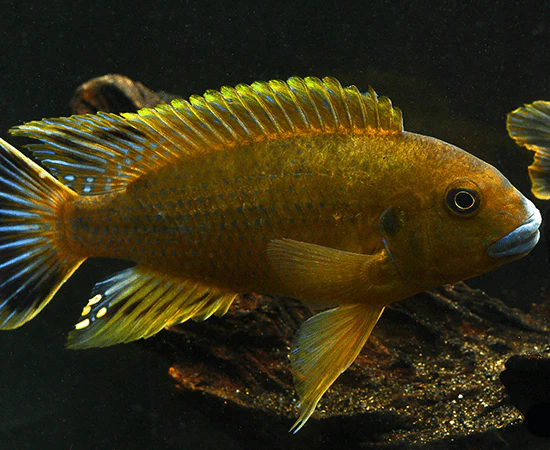
Remarks: Nanochromis parilus, commonly known as the blue Congo dwarf cichlid, is one of the many stunning members in their genus. While young fish are mostly a plain silver or tan, adults pop with color. Mature N. parilus have yellowish-orange bodies that shine with a blue and violet sheen in the light. Combined with the red and orange patterns in their fins and pink bellies in breeding females, they are quite a sight to see. N. parilus bear a heavy resemblance to their close relative, N. nudiceps, so much so that N. parilus had been mistakenly imported as N. nudiceps since their introduction to the hobby in 1952 until they were properly described as their own species in 1976. An easy way to tell the two species apart is to look at the top of the caudal (tail) fin. For N. nudiceps, they have a white or light blue stripe along the top edge of the caudal fin while in N. parilus, they lack this stripe and instead have alternating bands of yellow, red, black, or white vertical stripes.
Care for N. parilus is straightforward as they are hardy and generally peaceful fish compared to their relatives. In the wild, they inhabit rapids in the lower sections of the Congo River basin. Here, the water is mildly warm, well oxygenated, soft, acidic, and has a heavy current that N. parilus have adapted to handle with their slender bodies. Mimicking these conditions within the aquarium will help keep these dwarf cichlids happy and healthy as well as possibly promote spawning. They can be kept in mated pairs or small groups provided they have enough caves for them to claim and take shelter in. Any aggression shown by N. parilus is typically only between pairs fighting over a spawning site, males competing for females, territory squabbles with conspecifics, or when a pair is defending a brood. Otherwise, they are peaceful and can be kept with many other species that share their preferred water parameters, are not heavily aggressive, and are not small enough to swallow. For feeding, these omnivores are not very picky and will often eagerly eat anything offered. We recommend a diverse diet of many different prepared, frozen, and live foods to prevent any deficiencies.
Breeding N. parilus is almost as easy as their general care as they spawn in the typical cave-spawning fashion shared amongst others in their genus. Pairs form readily and often maintain strong, life-long bonds. To have the best chances of obtaining a pair, it is recommended to purchase a group of juveniles and allow them to pair off naturally as they grow. A pair of N. parilus that is provided proper parameters, given a healthy and robust diet, and a small cave to spawn in will almost certainly begin breeding. A female that is ready to spawn will become extremely rounded in the belly as she becomes full of eggs. Eggs are laid on the ceiling of the chosen cave where the male will fertilize them. After this, the female will take over care of the eggs, keeping them clean, oxygenated, and safe from predators. When the fry hatch and become free-swimming, the male will join the female in their care. N. parilus fry grow very quick so it isn’t uncommon for the pair to lay another clutch of eggs while their previous brood are still in the same tank making for a prolific breeding project.
Original: $19.99
-65%$19.99
$7.00Product Information
Product Information
Shipping & Returns
Shipping & Returns
Description
Remarks: Nanochromis parilus, commonly known as the blue Congo dwarf cichlid, is one of the many stunning members in their genus. While young fish are mostly a plain silver or tan, adults pop with color. Mature N. parilus have yellowish-orange bodies that shine with a blue and violet sheen in the light. Combined with the red and orange patterns in their fins and pink bellies in breeding females, they are quite a sight to see. N. parilus bear a heavy resemblance to their close relative, N. nudiceps, so much so that N. parilus had been mistakenly imported as N. nudiceps since their introduction to the hobby in 1952 until they were properly described as their own species in 1976. An easy way to tell the two species apart is to look at the top of the caudal (tail) fin. For N. nudiceps, they have a white or light blue stripe along the top edge of the caudal fin while in N. parilus, they lack this stripe and instead have alternating bands of yellow, red, black, or white vertical stripes.
Care for N. parilus is straightforward as they are hardy and generally peaceful fish compared to their relatives. In the wild, they inhabit rapids in the lower sections of the Congo River basin. Here, the water is mildly warm, well oxygenated, soft, acidic, and has a heavy current that N. parilus have adapted to handle with their slender bodies. Mimicking these conditions within the aquarium will help keep these dwarf cichlids happy and healthy as well as possibly promote spawning. They can be kept in mated pairs or small groups provided they have enough caves for them to claim and take shelter in. Any aggression shown by N. parilus is typically only between pairs fighting over a spawning site, males competing for females, territory squabbles with conspecifics, or when a pair is defending a brood. Otherwise, they are peaceful and can be kept with many other species that share their preferred water parameters, are not heavily aggressive, and are not small enough to swallow. For feeding, these omnivores are not very picky and will often eagerly eat anything offered. We recommend a diverse diet of many different prepared, frozen, and live foods to prevent any deficiencies.
Breeding N. parilus is almost as easy as their general care as they spawn in the typical cave-spawning fashion shared amongst others in their genus. Pairs form readily and often maintain strong, life-long bonds. To have the best chances of obtaining a pair, it is recommended to purchase a group of juveniles and allow them to pair off naturally as they grow. A pair of N. parilus that is provided proper parameters, given a healthy and robust diet, and a small cave to spawn in will almost certainly begin breeding. A female that is ready to spawn will become extremely rounded in the belly as she becomes full of eggs. Eggs are laid on the ceiling of the chosen cave where the male will fertilize them. After this, the female will take over care of the eggs, keeping them clean, oxygenated, and safe from predators. When the fry hatch and become free-swimming, the male will join the female in their care. N. parilus fry grow very quick so it isn’t uncommon for the pair to lay another clutch of eggs while their previous brood are still in the same tank making for a prolific breeding project.