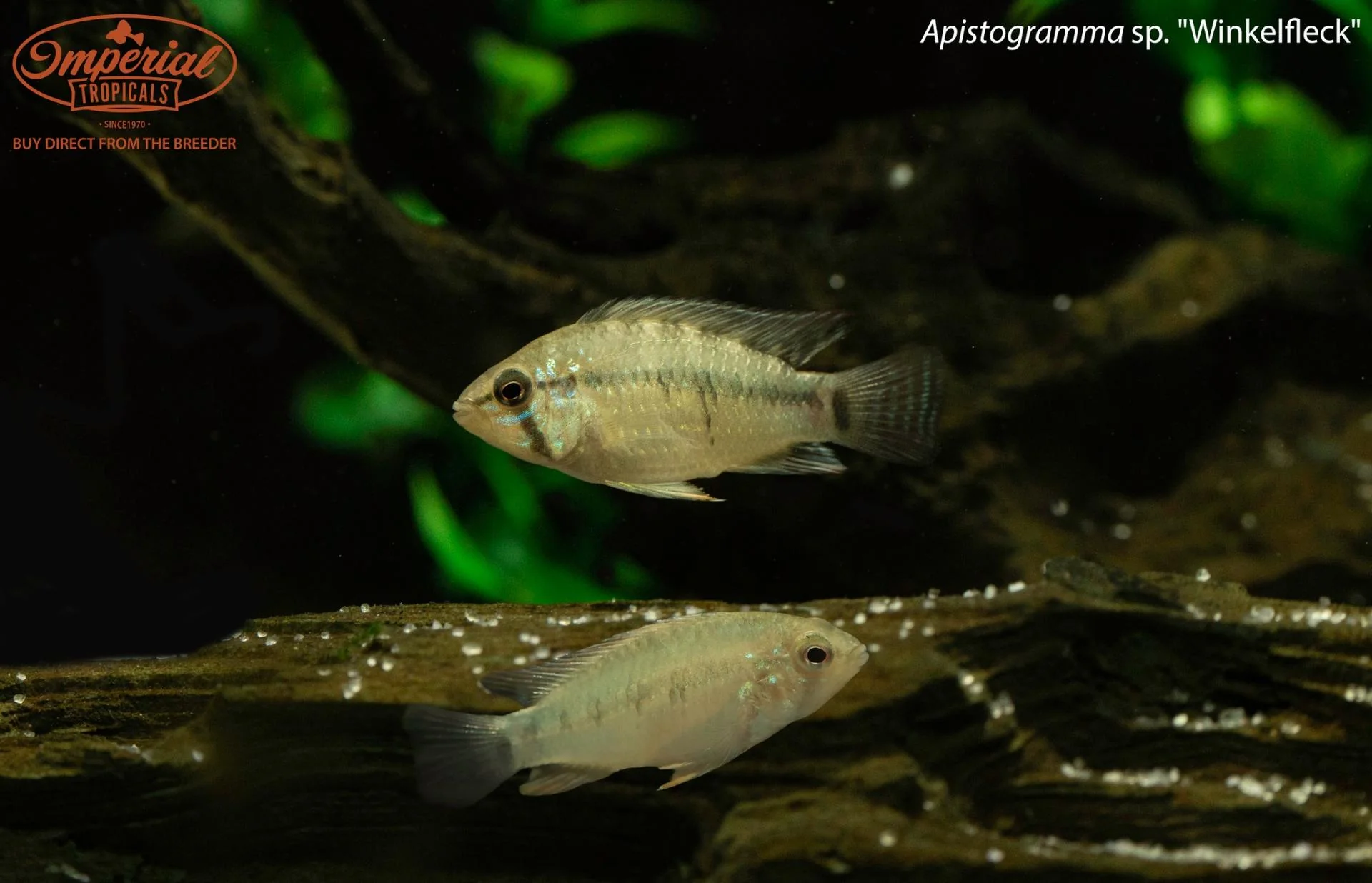
Apistogramma sp. "Winkelfleck"
Remarks: Apistogramma sp. "Winkelfleck", also known as the Winkelfleck apisto, has been in the hobby since 1999 but it remains an undescribed rarity. This is due to it only occasionally being imported, usually only by hobbyists instead of big distributers, and there being very few breeders. For this reason, we are excited to be able to offer some of these incredible dwarf cichlids that have been bred from wild parents right here in the United States!
The Winkelfleck apisto has the usual tall body shape of others in the Regani Apistogramma group. Mature females have the nicely contrasting black and yellow coloration found in most Apistogramma species. Mature males shine with their beautiful coloration consisting of blue iridescent scales set on a tan or silver body accented by fins with a mix of pink, orange and blue. They also will get small, pointed extensions to their ventral, anal, and dorsal fins. Both sexes have a black mask extending down from the eye, a tall black oval spot at the base of the tail fin, and a horizontal black stripe extending from their operculum to their tail that is solid in males but broken up into a dash pattern in spawning females. In a few populations, they will also have about five vertical black stripes across the body with some referring to these populations as Apistogramma sp. "Tiger Stripes".
Apistogramma sp. "Winkelfleck" has been known to occur in two collection points, the lower Río Marañón and the Río Orosa. Those from the lower Río Marañón are referred to with the A number A44 while those from the Río Orosa are referred to as A45. Fish collected from the lower Río Marañón have been noted as typically being lighter in color than those from the Río Orosa. As the fish we offer are on the lighter side, we suspect their parents to be the lower Río Marañón locality but this has yet to be confirmed.
With how rare Apistogramma sp. "Winkelfleck" are in the hobby, not much is known about their specific care requirements. Therefore, they should be treated as most other wild Apistogramma types. We recommend keeping these fish warm, in low current, and in soft, acidic conditions to keep them healthy and encourage the fish to show their best colors. Avoiding the use of bright lighting as well as providing plenty of small caves will encourage the Winkelfleck apisto to not hide all the time as well as encourage spawning. Avoiding tankmates that are overly aggressive or large enough to swallow dwarf cichlids will asl help in this regard. Like most apistos, feeding lots of tiny live foods such as freshly hatched baby brine shrimp can also help encourage spawning. Fry are guarded by one or both parents for several weeks. Dither fish such as small tetras and livebearers can be used to provide parents with targets to chase and help the Winkelfleck apisto feel more secure. If cared for properly, they can make a great addition to a peaceful community tank as well as a fantastic breeding project.
Original: $39.99
-65%$39.99
$14.00Product Information
Product Information
Shipping & Returns
Shipping & Returns
Description
Remarks: Apistogramma sp. "Winkelfleck", also known as the Winkelfleck apisto, has been in the hobby since 1999 but it remains an undescribed rarity. This is due to it only occasionally being imported, usually only by hobbyists instead of big distributers, and there being very few breeders. For this reason, we are excited to be able to offer some of these incredible dwarf cichlids that have been bred from wild parents right here in the United States!
The Winkelfleck apisto has the usual tall body shape of others in the Regani Apistogramma group. Mature females have the nicely contrasting black and yellow coloration found in most Apistogramma species. Mature males shine with their beautiful coloration consisting of blue iridescent scales set on a tan or silver body accented by fins with a mix of pink, orange and blue. They also will get small, pointed extensions to their ventral, anal, and dorsal fins. Both sexes have a black mask extending down from the eye, a tall black oval spot at the base of the tail fin, and a horizontal black stripe extending from their operculum to their tail that is solid in males but broken up into a dash pattern in spawning females. In a few populations, they will also have about five vertical black stripes across the body with some referring to these populations as Apistogramma sp. "Tiger Stripes".
Apistogramma sp. "Winkelfleck" has been known to occur in two collection points, the lower Río Marañón and the Río Orosa. Those from the lower Río Marañón are referred to with the A number A44 while those from the Río Orosa are referred to as A45. Fish collected from the lower Río Marañón have been noted as typically being lighter in color than those from the Río Orosa. As the fish we offer are on the lighter side, we suspect their parents to be the lower Río Marañón locality but this has yet to be confirmed.
With how rare Apistogramma sp. "Winkelfleck" are in the hobby, not much is known about their specific care requirements. Therefore, they should be treated as most other wild Apistogramma types. We recommend keeping these fish warm, in low current, and in soft, acidic conditions to keep them healthy and encourage the fish to show their best colors. Avoiding the use of bright lighting as well as providing plenty of small caves will encourage the Winkelfleck apisto to not hide all the time as well as encourage spawning. Avoiding tankmates that are overly aggressive or large enough to swallow dwarf cichlids will asl help in this regard. Like most apistos, feeding lots of tiny live foods such as freshly hatched baby brine shrimp can also help encourage spawning. Fry are guarded by one or both parents for several weeks. Dither fish such as small tetras and livebearers can be used to provide parents with targets to chase and help the Winkelfleck apisto feel more secure. If cared for properly, they can make a great addition to a peaceful community tank as well as a fantastic breeding project.